-
Your shopping cart is empty!


Your shopping cart is empty!
For a hair oil intended for the lengths, begin with a small amount and apply it where the product directions specify. Evaluate the finish before adding more. If the roots look greasy, changing placement may be more useful than switching to a different oil immediately.
“Hair oil” covers products used in different ways. A formulated finishing treatment, a pre-wash oil and a scalp product should not automatically share the same routine.
Flexi Care Brazilian Nut Oil Treatment has published directions for a small amount on clean, towel-dried hair, from mid-lengths to ends. Use those directions as the starting point for this product.
There is no need to extend a length-and-end application to the scalp just because the product is called an oil. Equally, advice about overnight scalp oiling does not establish how to use a formulated styling or conditioning treatment.
Check the current bottle rather than assuming that all products containing a familiar oil are used identically.
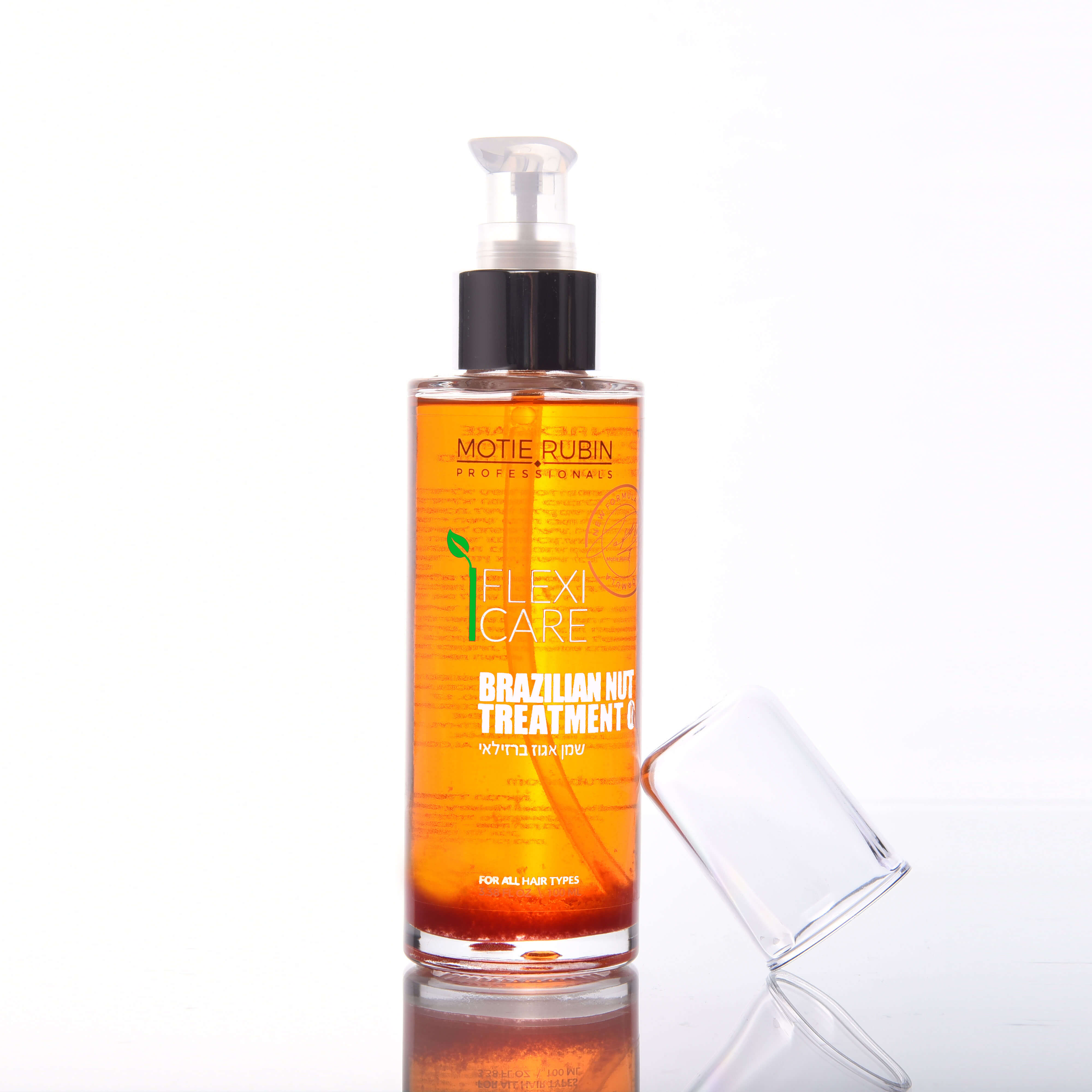
A fixed number of pumps is not a reliable universal instruction. Dispensers differ, and so do hair length, density and the area you want to treat.
Start within the label's guidance, distribute carefully and resist the habit of applying most of the product to the first section you touch. With dense hair, think about even coverage across sections. With fine hair, pay particular attention to whether the amount leaves the finish lighter or flatter than you intended.
Judge the result after the hair has dried. A product can feel different during application from the way it looks in your finished style.
An oil may be the final product you notice, but it might be sitting over a mask, leave-in and styling cream. If the overall result feels heavy, review the whole routine.
Ask what each layer contributes. You may need a conditioning step after washing but not several finishing layers. Alternatively, a small amount of oil on the ends may be useful while an extra application near the roots is not.
This is a practical comparison, not a rule that everyone should remove a particular product. Change one layer at a time so you can tell what makes a difference.
Use an oil treatment for its stated cosmetic purpose. Do not assume it will regrow hair, permanently repair split ends or make the hair resistant to any temperature of styling tool.
Likewise, a soft or glossy finish does not prove that another step is unnecessary. If your hair needs a different type of conditioning, choose that step deliberately instead of increasing the amount of oil until the hair feels coated.
Heat protection should be identified on the product label. The presence of an oil ingredient by itself does not establish a tested heat-protection claim.
That depends on the product. The published directions for Flexi Care Brazilian Nut Oil Treatment specify clean, towel-dried hair. Follow the current label for the product you have.
Its published application is from mid-lengths to ends. Do not turn it into a scalp treatment without product-specific guidance.
Look at the amount, the application area and the other leave-on products already present. At the next wash, adjust one factor and compare the dry result.
No. It is a choice within your routine, not a compulsory final layer for every hair type or style.
Explore a length-and-end treatment: View Flexi Care Brazilian Nut Oil Treatment and its application directions.
